In this story
Give each signal a clear jobSeparate access from appearanceTreat citations as observable outputsBuild an evidence record that can be comparedKeep commercial attribution on a separate trackTurn the evidence into a useful decisionSourcesCorrectionsSEO, AEO and GEO describe useful priorities. The next step is to connect those priorities to evidence: whether content was accessible, appeared in an answer, attracted a visit or helped generate a customer.
Give each signal a clear job
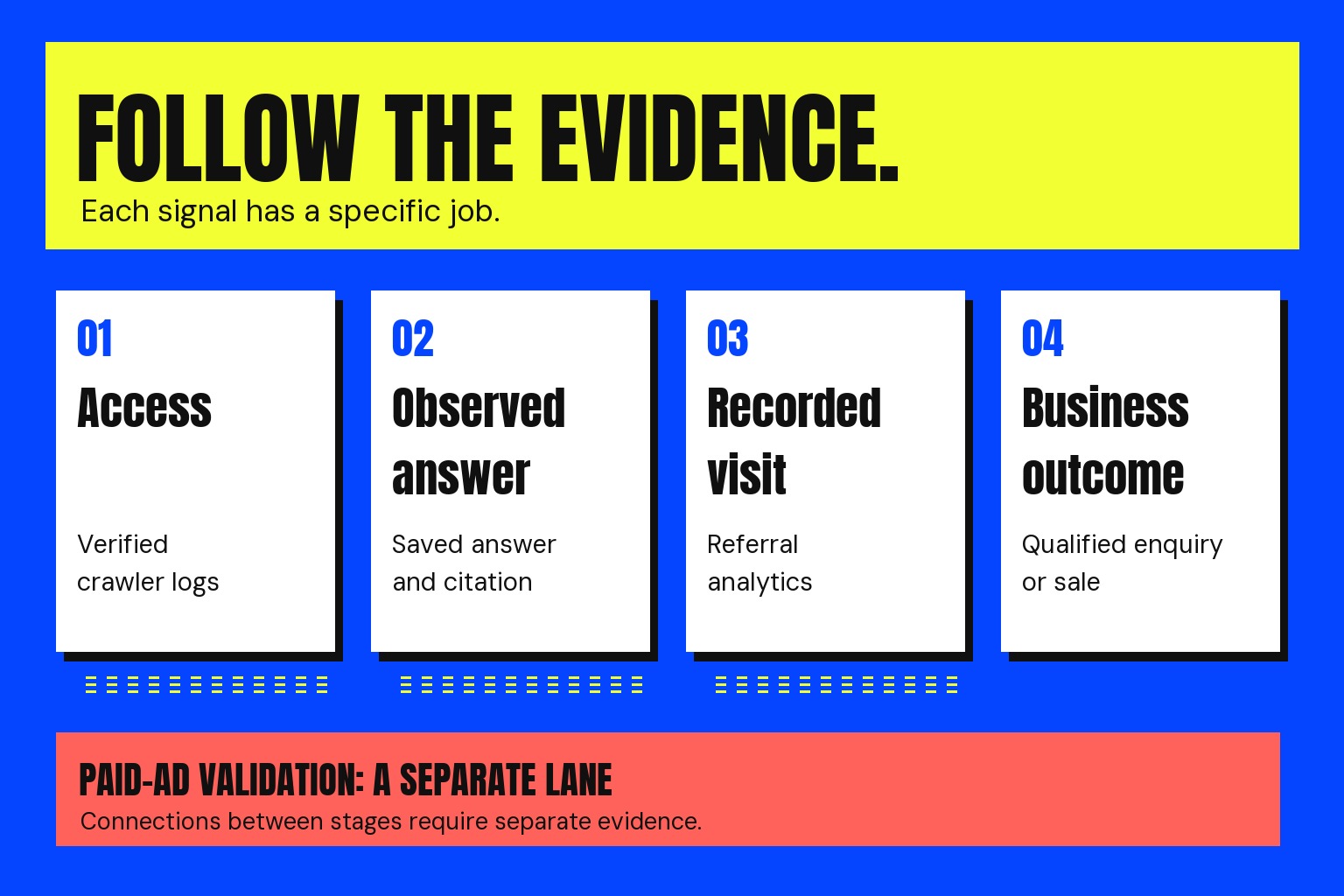
Each signal answers a different question. Keep those questions visible and a report becomes more useful: it shows what changed, what the observation establishes and which action should follow.
This article focuses on classifying evidence. For a practical reporting workflow, use the AI-search measurement scorecard; for repeated observations, use the search-comparison protocol.
| Stage | Evidence to retain | What it establishes |
|---|---|---|
| Access | Verified crawler logs and response status | A specific system could retrieve the page |
| Observed answer | Saved answer, source URL and supporting passage | A mention, citation or recommendation on that surface |
| Recorded visit | Referral analytics and landing URL | A measured website visit |
| Business outcome | Qualified enquiry, booking or sale record | An outcome under the recorded attribution rules |
Separate access from appearance
Google describes crawling, indexing and serving results as distinct stages. Use each stage to diagnose a different part of discovery: a successful crawl establishes access; indexing and appearance have their own evidence. Google also states that payment cannot buy more frequent crawling or a higher ranking. Google Search Central: How Search works.
For supporting links in AI Overviews and AI Mode, Google says a page must be indexed and eligible for a search snippet. Its guidance does not require special AI markup or a separate machine-readable AI file. Google also explains that these features may search across related subtopics, and that their responses and supporting links can differ. Google Search Central: AI features and your website.
The practical measurement boundary is straightforward: technical eligibility establishes an opportunity to appear. Save the observed answer to establish actual inclusion.
OpenAI makes another distinction explicit. OAI-SearchBot supports ChatGPT search; GPTBot collects content that may be used for model training. Their controls are independent. ChatGPT-User handles certain user-triggered visits and does not determine search eligibility. OpenAI: Overview of crawlers.
Label server logs precisely. A verified search-crawler request supports a claim about access. Record a citation, training-related setting or customer impression only when the corresponding evidence is available. Start with the request's role, then state what it establishes.
Treat citations as observable outputs
An answer can mention a company without linking to its website. It can cite a company’s page while discussing a competitor. It can also cite a page that only partially supports the surrounding statement.
These outcomes deserve separate records:
- Brand mention: the company appears in the answer text.
- Owned-domain citation: a visible source link points to its website.
- Recommendation: the answer actually proposes the company as an option.
- Accurate attribution: the cited page supports the associated claim.
OpenAI’s web-search API documentation distinguishes inline citations from the broader list of sources consulted. A citation inventory is therefore not a complete inventory of retrieval activity in that API workflow. Treat an API test and a consumer ChatGPT session as separate surfaces with their own collection records. OpenAI: Web search.
For SGEO reporting, use the recorded answer and its visible evidence as the defensible unit. Open the linked page, identify the passage supporting the statement, and record whether the link, mention and recommendation refer to the same business and service.
Build an evidence record that can be compared
Start with questions that reflect actual customer decisions. Separate discovery, comparison and verification questions, and keep branded prompts apart from unbranded ones.
Before changing content, preserve a baseline question set. Record the exact wording, product or surface, date, language, location settings where available, and whether the test used a fresh conversation. Save the answer and its citations. Record failures and missing AI answers as their own states.
Define the denominator before calculating a rate and report the number of valid observations beside it. If the product, settings or question set changes, mark the break in the series. These are proposed measurement practices, not the results of an experiment. The measurement guide explains how to turn the records into a repeatable scorecard.
Keep commercial attribution on a separate track
A citation is evidence of appearance. A recorded referral is evidence of a visit. A tracked enquiry is evidence of an action under the measurement system’s attribution rules.
Connect those events using the records available. Someone may read an answer and later visit directly. A referral may arrive without enough context to reconstruct the original question. A conversion may follow several channels. State the observed connection rather than assigning all subsequent revenue to the last AI mention.
Maintain separate views for sampled answer visibility, identifiable referral traffic and business outcomes. Compare their direction and use differences to investigate the next question. Keep content releases, demand changes and platform changes alongside the observations so the interpretation remains inspectable.
Paid exposure needs its own category too. OpenAI documents OAI-AdsBot as a visitor to pages submitted as ads, used for safety validation and ad relevance. Classify that visit as ad validation rather than an organic citation. OpenAI: Overview of crawlers.
Turn the evidence into a useful decision
Give each finding a clear next action. An access problem calls for a technical repair. An inaccurate answer may point to unclear source material. A relevant citation with weak enquiry results directs attention to the landing experience and lead handling.
A useful conclusion states the surface, observation period, question sample and metric. It separates a repeatable improvement in sampled citations from a verified increase in enquiries, giving each result a clear place in the report.
This is a practical foundation for ambitious SEO, AEO and GEO work: make the content accessible, strengthen the information customers need and use an evidence trail to decide what to improve next. For SGEO, the most valuable optimization is one a team can explain, inspect and test again.
Sources
- 1Google Search Central: How Search works
Crawling, indexing and serving as separate stages; payment does not buy crawling frequency or ranking.
- 2Google Search Central: AI features and your website
Supporting-link eligibility, ordinary SEO foundations and query fan-out.
- 3OpenAI: Overview of crawlers
Search, training, user-triggered requests and ad-validation crawler roles.
- 4OpenAI: Web search
Inline citations and the wider source list in the web-search API workflow.
Corrections & updates
Sources checked 2026-11-01. Substantive updates will record the date, change and reason.
Read our corrections approach ↗